
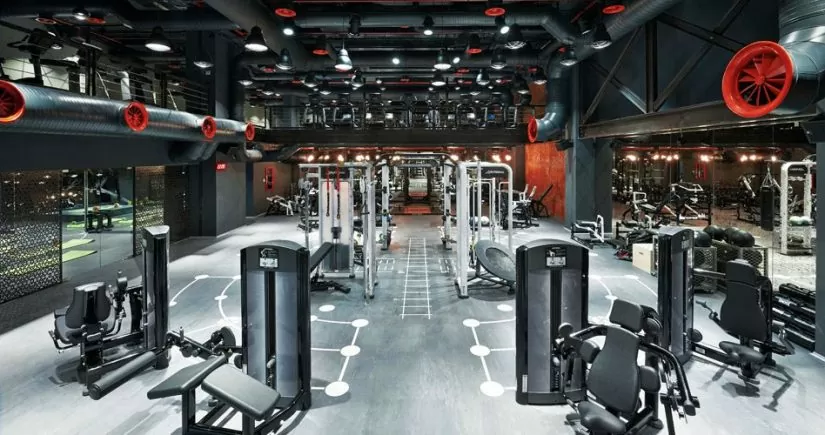
According to building codes, in all spaces where people are even temporarily present, the ventilation system must ensure proper air flow, prevent stagnation, and remove any unpleasant odors that accumulate over time.
In buildings and individual rooms where visitors engage in sports activities, an appropriate ventilation system must be selected to create an optimal microclimate.
It is crucial to consider factors affecting air exchange. If the air in the rooms is saturated with carbon dioxide, training becomes less effective. To create comfortable conditions, the supply unit should provide about 20 m³/h of fresh air for each spectator and 80 m³/h for each customer.
Ventilation functions
In such spaces, air exchange must occur regularly. To reduce the volume of incoming air needed, rooms are often constructed with high ceilings. This design feature allows the air to refresh much faster and slows down the accumulation of critical amounts of carbon dioxide.
Each individual room must have optimal climate conditions. This applies to showers, restrooms, treatment rooms, etc. Regarding air exchange requirements, it is recommended to install individual ventilation systems to maintain climate conditions in specific rooms.
It is equally important to consider the maximum number of people who can be in the facility. Depending on this, the required capacity of the ventilation unit is calculated, which should supply the recommended amount of fresh air per visitor.
Calculation details
The required amount of supply air depends directly on the visitor’s activity level. As previously mentioned, each non-exercising person requires at least 20 m³/h of fresh air, while each athlete requires at least 80 m³/h. For employees working in offices, this standard ranges from 40 to 50 m³/h, depending on the tasks performed. To determine the capacity of the ventilation unit, you can use the formula: L = N×Lnorm, where N is the number of people in the room, and Lnorm is the established fresh air dose that should be provided to each person, depending on their activity level.
To calculate the required ventilation considering the area and air exchange rate, you can use the formula: L = n×S×H, where n is the air exchange rate, S is the area, and H is the height of the room. By plugging in the available data, you get the values that can be used to assess the required capacity of the ventilation unit.
| Pomieszczenie | Indoor temperature t, °C | Air exchange rate (m³/h) | |
| Nawiew | Wywiew | ||
| Strength training rooms, acrobatics rooms, and individual warm-up areas | 16 | 2 | 3 |
| Sports halls without seating for spectators (excluding rooms for rhythmic gymnastics) | 15 | Designed to provide at least 80 m³/h of outdoor air per athlete | |
| Rooms for rhythmic gymnastics, choreography, and sports halls with seating for spectators | 18 | Calculated to ensure at least 80 m³/h of outdoor air per athlete and 20 m³/h per spectator | |
| Training rooms, spaces for coaching and officiating staff, press, administration, etc. | 18 | 3 | 2 |
| Dressing | 16 | – | 2 |
| Workshop halls | 16 | 2 | 3 (including local exhaust systems) |
| Pomieszczenie straży pożarnej | 18 | – |
2 |
| Changing rooms by the showers and massage rooms | 25 | Według balansu powietrza |
2 (przez prysznice) |
| Showers | 25 | 5 | 10 |
| Gabinety masażu | 22 | 4 | 5 |
| Public restrooms | 16 | – | 100 m³/h for a toilet bowl or urinal |
| Toilets in the changing rooms | 20 | – | 50 m³/h for the toilet bowl or urinal |
| Storage rooms with permanent staff presence | 16 | – | 2 |
| Storage rooms with short-term staff presence | 10 | – | 1 |
| Dryer for sports clothing | 25 | 2 | 2 |
| Gym | 16 | – | 80 m³/h |
| Sauna | 16* | – | According to calculations |
Ventilation of sports halls
For each space where sports activities will take place, the ventilation system is selected individually. For example, a compact monoblock ventilation unit is sufficient for smaller areas. This is the best way to ensure excellent ventilation in small spaces.
For larger areas, a supply and exhaust ventilation system is recommended. Its installation is quite complex, and the cost is significantly higher than that of a monoblock system. The supply unit delivers fresh and filtered air to the room, while the exhaust unit removes unpleasant odors, accumulated toxins, and carbon dioxide. If needed, air conditioners cool the air, and heaters warm it. To reduce costs, ventilation units with heat recovery are installed.
As you can see, providing comfortable conditions for visitors to gyms and fitness clubs requires considering many factors that affect indoor air quality. Our specialists will complete all assigned tasks with high quality and on time. Trust the professionals, and you won’t regret your choice!
 (2 głosów, średnia: 5.00 poza 5)