
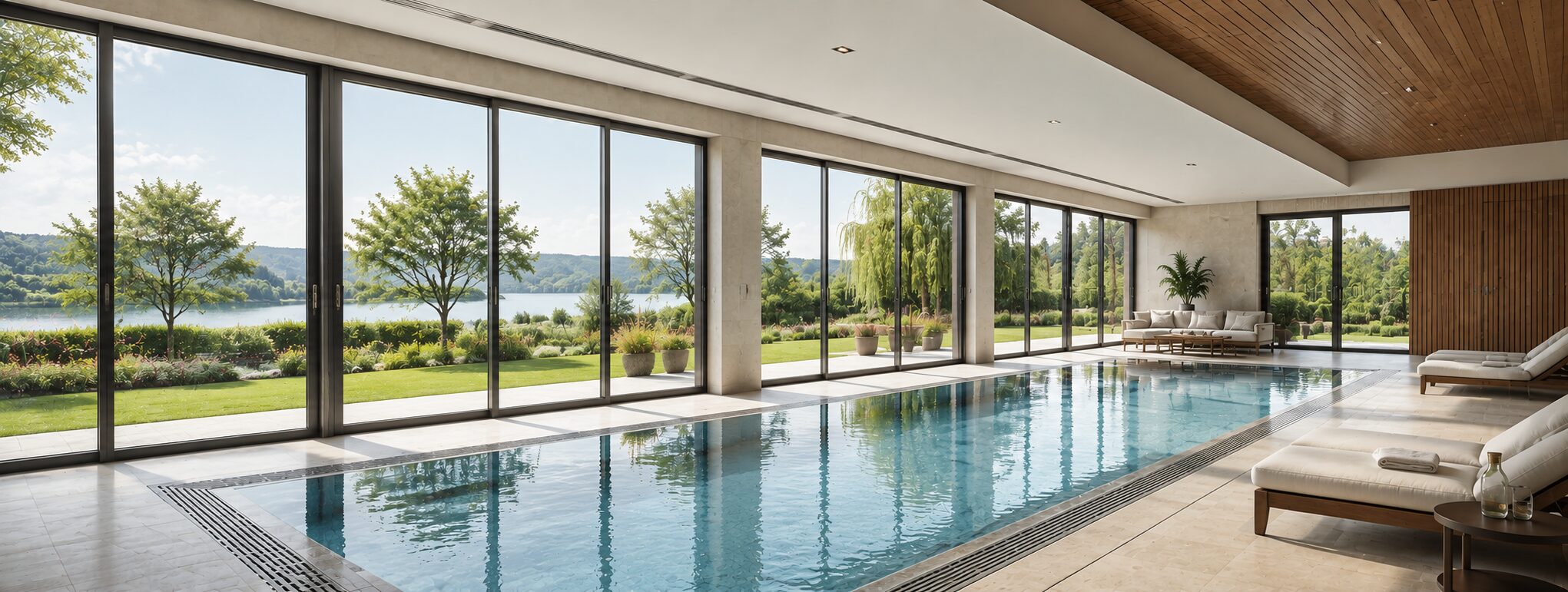
Ventilating a swimming pool hall is one of the most demanding tasks in the HVAC industry — high humidity, elevated temperature and constant water evaporation quickly lead to condensation on walls, damage to finishes, corrosion of metal structures, and the growth of mould and fungus if the system isn’t right. Even under optimal conditions — 26°C and 50% humidity — around 220 g of water vapour per hour evaporates from every square metre of the water surface. Once room humidity exceeds 80%, condensation starts running down the walls, unpleasant odours appear, and conditions become favourable for mould and fungus growth.
In Warsaw and the surrounding area, where sports, hotel and residential swimming pool halls operate year-round, a well-designed pool ventilation and dehumidification system isn’t an optional extra — it’s a precondition for the building’s durability and the comfort of the people using it. Kliwenta designs, installs and services ventilation systems for swimming pool halls in Warsaw and across the entire Mazowieckie region — from small pool zones in single-family homes to sports and hotel swimming pools.
🔥 Heat recovery + heat pump — the lowest running costs
Why pool ventilation needs a different approach
Ventilation systems in pool rooms differ from those used in residential buildings because they must perform three functions at once: provide air exchange, reduce and stabilise humidity, and remove unpleasant odours — all while keeping both the water and air at a comfortable temperature. It’s also important that the ventilation system of a swimming pool hall be separate from the ventilation of the rest of the building — it must not depend on it, because humid air from the pool hall should not spread into other rooms.
Poland has not yet developed its own detailed standard for pool ventilation design — Polish designers use the German guideline VDI 2089 (Blatt 1) for this purpose, supplemented with general national regulations, primarily the Ordinance of the Minister of Infrastructure on the technical conditions that buildings and their location should meet. Below are the key parameters we use when designing pool ventilation in Warsaw:
| Parameter | Recommended value | Why it matters |
|---|---|---|
| Water temperature | usually 23–32°C, depending on the pool’s purpose | The starting point for selecting all other parameters |
| Air temperature | 2–4°C higher than the water temperature (in winter and the transitional season) | Limits evaporation and the feeling of cold for people leaving the water |
| Relative humidity | optimally around 55% at 30°C, in practice should not exceed 65% | Above 65% the risk of condensation rises, above 80% — mould, fungus and corrosion |
| Air velocity in the occupied zone | 0.1–0.15 m/s | Higher velocity causes draughts for wet people and speeds up evaporation from the water surface |
The exact design parameters depend on the type of facility (sports, hotel or residential pool), how it is used, and the season — we select them individually for each project, following the VDI 2089 methodology.
Pool ventilation systems we use
For every facility we select an individual set of equipment, taking into account the hall’s volume, heat load and humidity level. Below are the most commonly used solutions — from the simplest to the most efficient.
Separate supply and exhaust systems
Sometimes supply and exhaust ventilation systems are installed separately. They are similar to those used in residential buildings, with the difference that they must have automatic humidity control. The supply unit consists of an air intake with a damper — preventing cold air from flowing into the room — as well as a fan, filter and heater, which clean and heat the incoming air. The exhaust system relies on a fan that removes stale air through exhaust ducts to the outside.
Combined supply-and-exhaust system
The required air exchange rate in a pool hall depends on the season — in winter less air needs to be supplied than in summer, because humidity changes both outside and inside the building. In such cases we recommend variable recirculation, which allows excess moisture to be removed by controlling only the air supply.
Correct air distribution is a basic condition for the system to work efficiently: humid air rises upward while dry air sinks down, which is why it is extracted from the upper zone of the room. The supply air stream should be directed along the windows and walls — this limits the risk of condensation and makes temperature control easier. In facilities with a glass roof, supply air should be directed along its surface, with extraction on the opposite side from the supply.
Supply-and-exhaust system with air dehumidifiers
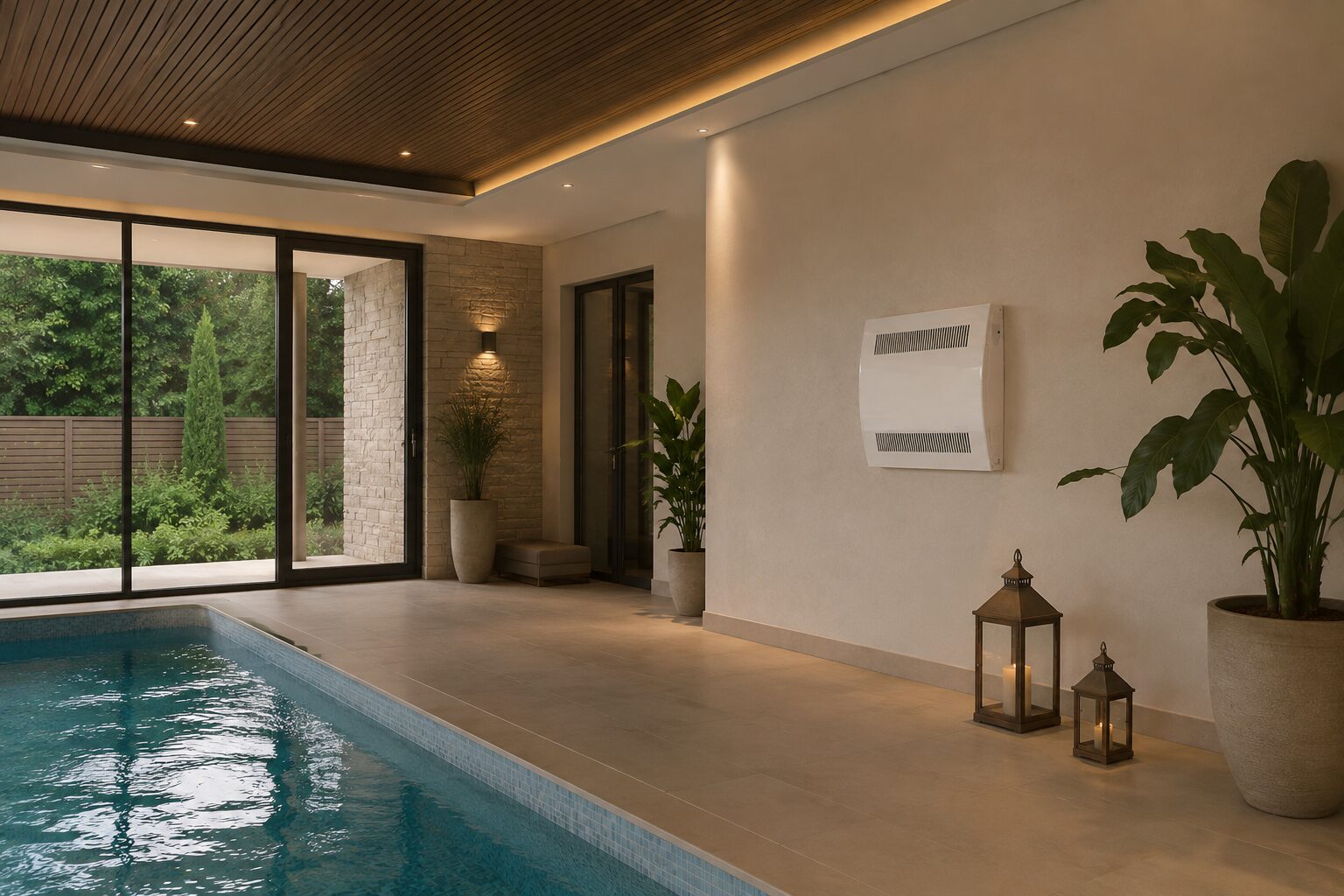
A more expensive solution to buy, but in practice more cost-effective than installing separate dehumidifiers, because it reduces energy consumption. Dehumidifiers are distributed evenly around the room — as wall-mounted or recessed units. Humid air enters the dehumidifier, condensate is drained through the drainage system into the sewer, and low-humidity air returns to the room. Because dehumidifiers operate in recirculation mode, we recommend installing them together with a supply-and-exhaust system rather than as a stand-alone solution.
Correct air distribution in a swimming pool hall
Choosing the right air handling unit is only half the job — where and how the air is distributed matters just as much. We follow two rules here: in winter, glazed surfaces are colder than the rest of the room and most prone to moisture condensation, so the supply air is installed low, under the windows, with the stream directed vertically upward — creating what’s known as an air curtain, which both warms the glass and protects it from condensation. The second rule follows from physics: humid air rises upward, so the extract is usually placed in the middle of the hall, just under the ceiling (smaller facilities also use side extraction).
Slot diffusers are typically installed 20–30 cm from the wall, with an air discharge velocity of around 4–5 m/s, which ensures the air jet has sufficient throw. Under technical regulations, the temperature of air supplied through a slot diffuser should not exceed +45°C.
Supply-and-exhaust system with heat recovery and a heat pump — the lowest running costs
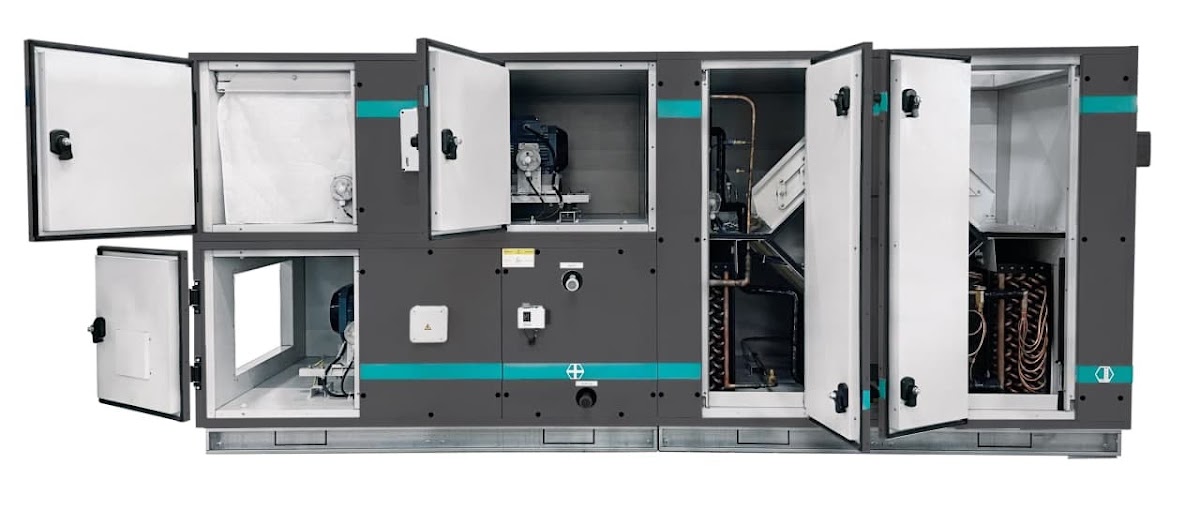
The most advanced solution used in pool air handling units is a three-stage system: recirculation + a heat recovery exchanger (most often a cross-flow or counter-flow plate exchanger) + a built-in heat pump. The heat pump’s evaporator is placed on the exhaust air side, after the heat recovery exchanger — this lets it recover additional energy from air that is leaving the building anyway. The condenser is used to further heat the supply air, and in some systems — also to heat the pool water or domestic hot water.
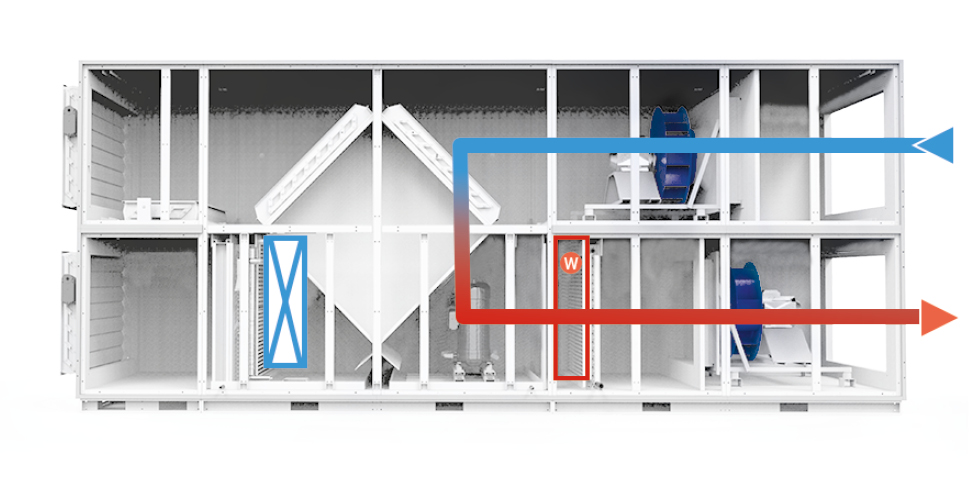
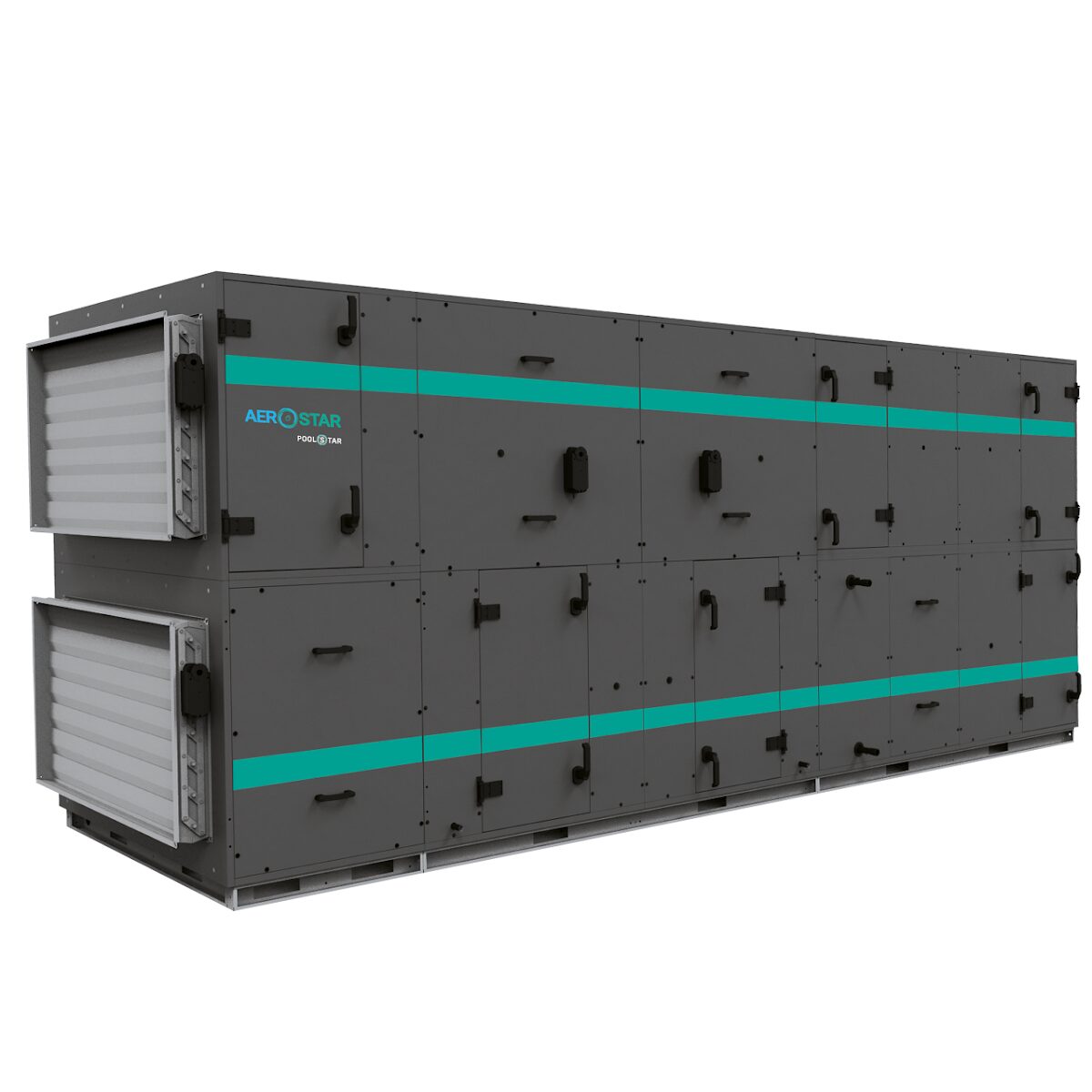
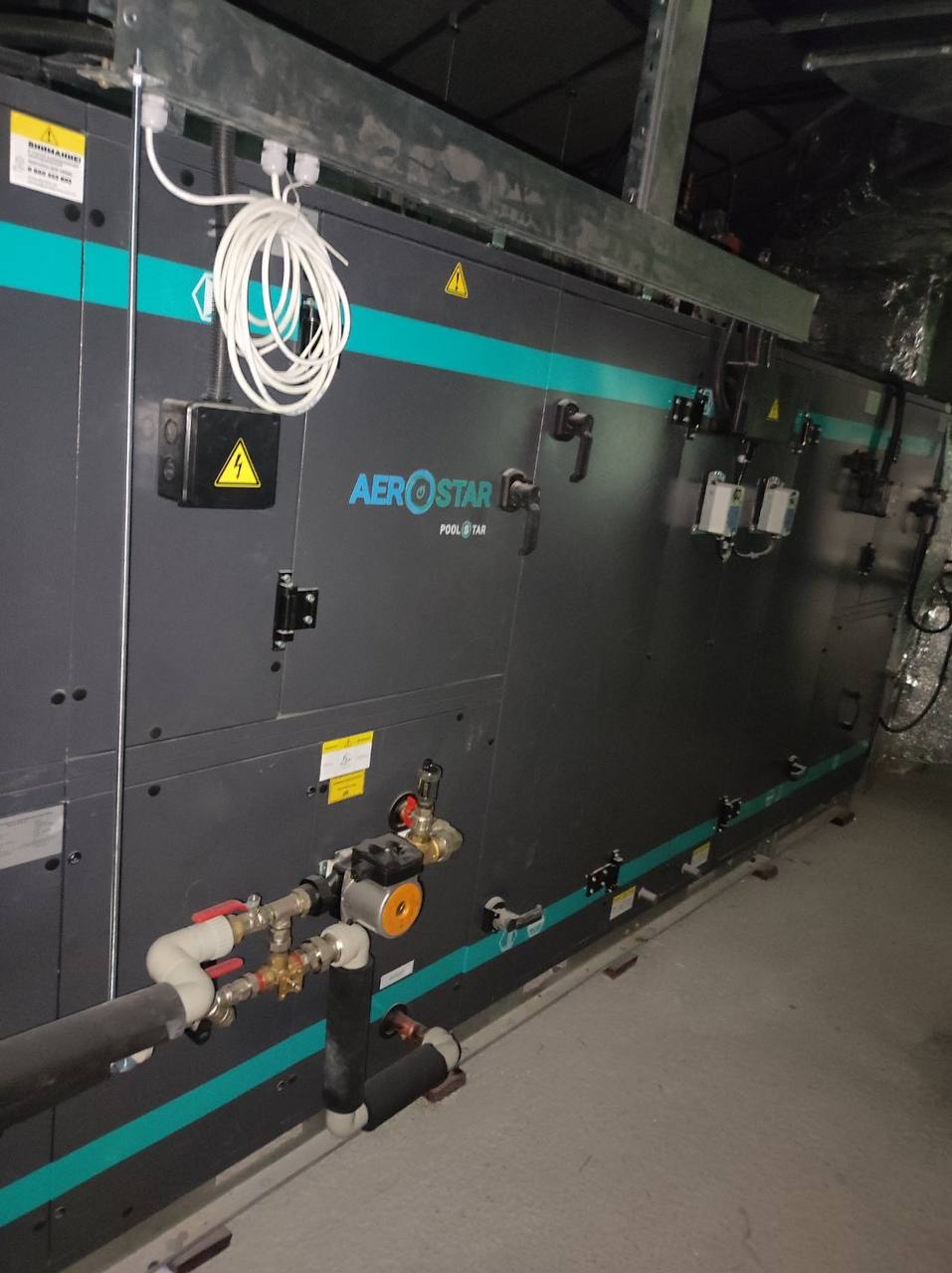
An example of equipment built with this technology is the PoolStar range of air handling units — they combine a cross-flow heat recovery exchanger with a built-in heat pump, providing two-stage heat recovery from the exhaust air. Two variants are available, selected depending on the scale of the facility:
- PoolStar — a version designed for larger facilities: hotel and sports pools, aquaparks, regardless of their size;
- PoolStar-Compact — a compact version, suited to smaller, residential pool zones, where saving space in the plant room matters.
It’s worth having realistic expectations about the savings: energy analyses published in Polish industry literature (including by the Silesian University of Technology) show that a good two-stage heat recovery exchanger alone (without a heat pump) can reduce primary energy demand by a few percent compared with a single-stage system, and adding a heat pump to an already well-designed exchanger typically brings a further few percent of savings in winter — because the heat pump consumes electricity to drive its compressor, which partly offsets the thermal gain. In other words: in winter, a well-selected heat recovery exchanger on its own accounts for most of the energy savings.
The real advantage of a heat-pump system shows up in other situations:
- In summer and transitional seasons — when heat recovery from the exchanger doesn’t apply, the heat pump can operate in cooling-and-dehumidifying mode, keeping humidity stable without having to bring in excessive amounts of fresh outdoor air.
- Supporting pool water heating — heat from the condenser can be directed to heat the pool water or domestic hot water, further reducing the facility’s overall running costs.
- Stable operation outside opening hours (non-bathing mode) — the automation can maintain a slightly lower indoor temperature with minimal outdoor air intake, without risking excessive cooling or dampness in the hall.
- One unit instead of several — fewer units mean less space needed in the plant room and simpler servicing compared with a separate heater and dehumidifier.
That’s why a system with heat recovery and a heat pump works best in facilities that operate year-round and are used intensively — hotel, sports and spa pools — where both stable summer operation and the ability to help heat the water matter. For smaller, seasonal residential pools, where lower investment costs are the priority, a well-selected two-stage heat recovery exchanger combined with a separate dehumidifier is often a sufficient and more cost-effective solution.
Corrosion-resistant materials — what to look for when choosing a pool air handling unit
Pool ventilation units work in constant contact with moisture and chlorine compounds, so their construction must be corrosion-resistant — otherwise the unit’s service life is measured in months, not years. The most exposed components are the heat exchangers and heat-pump evaporators, where moisture condenses. Good pool ventilation solutions use:
- heat recovery exchangers made of polypropylene (fully corrosion-resistant, with efficiency comparable to aluminium exchangers) or epoxy-coated;
- heat-pump evaporators made of acid-resistant steel, installed so that condensate is continuously drained away;
- casings made of painted aluminium profiles with an enhanced corrosion-resistant coating, with a sheet-metal floor;
- dampers made of aluminium profiles, and automation gears made of chlorine-resistant plastic.
Choosing the right materials is one of the reasons why it’s worth entrusting pool ventilation installation to a company specialising in this type of facility, rather than a standard air handling unit intended for residential or office buildings.
Comparing the solutions
| Solution | Investment cost | Winter running costs | Summer operation | Best for |
|---|---|---|---|---|
| Basic supply-and-exhaust | Lowest | High (no heat recovery) | Requires a large share of outdoor air | Small seasonal pools |
| Supply-and-exhaust + separate dehumidifier | Medium | Medium | Good humidity control, no cooling | Year-round residential pools |
| With a two-stage heat recovery exchanger | Medium–high | Low | Limited (no recovery when there’s no temperature difference) | Year-round facilities prioritising heating costs |
| With heat recovery and a heat pump (e.g. PoolStar / PoolStar-Compact) | Highest | Low (slightly lower than the exchanger alone) | Very good — cooling and dehumidifying | Hotel, sports and spa pools, year-round facilities, pool water heating |
Calculator: how much water evaporates from a pool and how much air needs to be supplied
The amount of water vapour evaporating from the water surface is the starting point for selecting any pool ventilation or dehumidification system. The calculator below computes it using the formula from the German VDI 2089 guideline (Dalton method), experimentally verified by Poznań University of Technology (I. Rzeźnik, “Study on water evaporation rate from indoor swimming pools”, E3S Web of Conferences 22, 00150, 2017):
ṁw = ε × (pw″ − pw) × F / 1000 [kg/h]
where: F — water surface area [m²], pw″ — saturated vapour pressure at water temperature [hPa], pw — vapour pressure in the hall’s air [hPa], ε — usage-intensity coefficient (5 for a pool at rest, 20 for a public pool in use, 28 for a recreational pool with water attractions).
Air dehumidifiers
The way a dehumidifier works is clear from its name — the device significantly reduces humidity in the room, while easing the load on the ventilation system and reducing the energy it needs to run. This doesn’t mean, however, that a dehumidifier can fully replace ventilation — every device, including the dehumidifier itself, generates heat, and the air in the pool hall still needs to be exchanged and filtered.
Which dehumidifiers we use
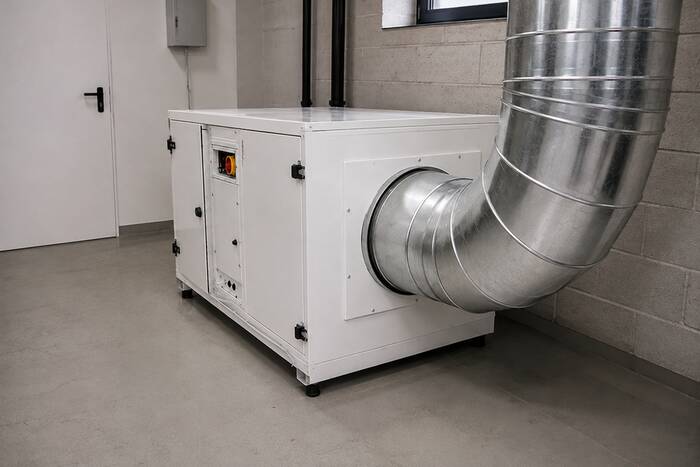
In practice we most often install condensing dehumidifiers — air condenses inside the dehumidifier’s casing on a cold exchanger, condensate is drained through the drainage system into the sewer, and dehumidified air — after thorough cleaning — returns to the pool hall. These units also filter the air. Among the most proven models on the market are Danvex and Dantherm, which Kliwenta’s specialists recommend to clients for their reliability and available servicing.
How we size a dehumidifier
The primary sizing parameter is the size of the water surface. As a rough guide, the recommended ventilation rate is 1 m³/h of air per 1 m² of water surface, while the dehumidifier’s own capacity is selected based on the evaporation rate — which depends on the water and air temperature, the target humidity, and how intensively the pool is used (more people and more water movement mean faster evaporation).
Dehumidifiers are distributed evenly around the room — as wall-mounted or recessed units — and we recommend installing them together with a supply-and-exhaust ventilation system rather than as a stand-alone solution replacing ventilation. Because of their low energy use, dehumidifiers work especially well in single-family homes, in pool rooms where building a full air handling unit with heat recovery isn’t always economically justified.
What information we need to design the system
Every pool room requires an individual approach to ventilation design. For Kliwenta’s engineers to prepare an equipment selection and quotation, they need the following information:
- the structure and thickness of the pool hall’s walls;
- the size of the room (volume);
- the dimensions of the water surface;
- information about the power available for heating the air;
- individual preferences for air and water temperature;
- a floor plan showing where the client would like the equipment installed.
Want to choose the optimal ventilation and dehumidification system for your swimming pool hall? Get in touch with Kliwenta — we’ll prepare a free quotation and design tailored to your facility, whether it’s a residential pool zone or a hotel swimming pool.
Common problems and questions
Why do the windows and walls in the pool hall “sweat” even though the ventilation is running?
The most common cause is that the system’s capacity is too low relative to the rate of water evaporation, or the lack of automatic humidity control. It can also happen that the supply air stream isn’t directed along the windows and walls, so it doesn’t limit condensation in those zones. The solution is to adjust the automation settings or — if the system was poorly sized from the start — to expand it with an additional dehumidifier.
Mould is appearing on the ceiling or walls — what does that mean?
Mould and fungus start to develop when the room’s relative humidity stays above 80% for a long time. That’s a sign the ventilation system can’t keep up with dehumidification — this usually calls for an urgent review of the equipment selection, and in the meantime, reducing the water temperature or the number of people using the pool at the same time.
Can a dehumidifier completely replace ventilation in a swimming pool hall?
No. A dehumidifier operates in recirculation mode and reduces humidity, but it doesn’t provide air exchange or remove unpleasant odours and chlorine compounds hanging over the water surface. We recommend combining a dehumidifier with a supply-and-exhaust system rather than using it as a stand-alone solution.
Does the pool hall need to be cooled separately in summer?
With a unit that has a built-in heat pump, usually not — the device can operate in cooling-and-dehumidifying mode at the same time. With simpler supply-and-exhaust systems, in summer you simply increase the share of fresh, cooler outdoor air.
Can pool ventilation be connected to the building’s existing ventilation?
We don’t recommend this. The ventilation system of a swimming pool hall should be separate from the ventilation of the entire building — humid air from the pool should not spread into other rooms, which is why the pool hall is usually kept at a slightly lower pressure than its surroundings.
How often does a pool ventilation system need servicing?
Given the harsh operating conditions (high humidity, chlorine fumes), we recommend service inspections at least twice a year — covering filters, exchangers, automation and components exposed to corrosion.
How much does running a pool ventilation system actually cost?
It depends mainly on the solution chosen. A system with heat recovery and a heat pump generates noticeably lower energy bills than a basic system with a separate heater and dehumidifier — the difference can be significant, especially for facilities operating year-round. We prepare a precise running-cost estimate individually at the quotation stage.
See also
- Installation of ventilation systems
- Servicing of ventilation and air conditioning systems
- Industrial ventilation
- Air conditioning in high-rise buildings and large rooms
