
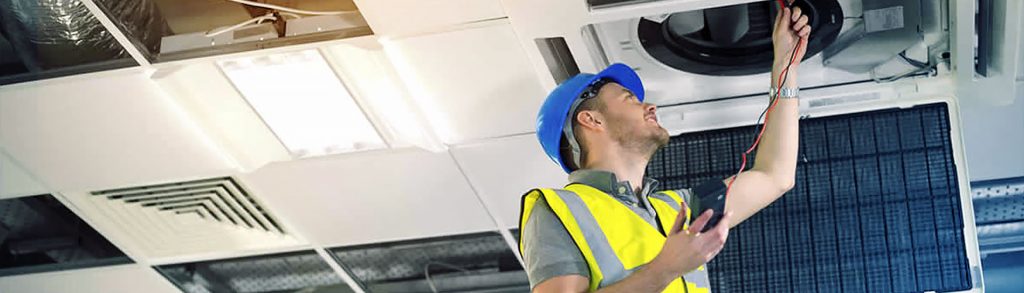
Ventilation Installation
The principle of installing ventilation systems is quite simple: you install basic components such as fans, and the specialists configure them so that the equipment can correctly perform its functions in the future. However, it’s crucial that the installation is carried out strictly according to the design, because only in this way can the installers guarantee the proper functioning of all elements.
Ventilation System Installation
The installation of a ventilation system can begin only after its design is completed. However, you should not cut corners; it’s better to entrust the installation to experienced specialists in this field. To allow them to do their job properly, you need to provide them with the following materials:
- Dimensional drawings of the ventilation system, indicating all equipment and connections;
- Drawings of assembled nodes (separately) and cross-sections of complex parts of the system.;
- An installation diagram showing all the dimensions of air ducts, shaped components, and custom parts of the system.
After providing this information, the specialists from Kliwenta always check if it aligns with the actual characteristics of the building. If there are any discrepancies, modifications must be made. After that, the installation of the equipment can begin.
Components Required for Installing a Ventilation System
To install a ventilation system, the installers require galvanized steel air ducts and fittings. Corrugated air ducts are also used during installation, as in some cases, steel ducts cannot or should not be used. Specialists also need insulation materials, perforated tape, reinforced tape, etc.
Information for Clients
Air ducts must be installed strictly in accordance with technical drawings. All connections must be hermetically sealed to prevent unpleasant odors from escaping the air ducts and to avoid air leakage during equipment operation. If the ventilation system installation is done incorrectly, noise may occur during equipment operation.
Nuances Related to Ventilation System Installation
The quality of the design plays a role because it directly affects how well installers perform their job. After all, experienced designers create it with ease of access for maintenance technicians in mind. Specialists from Kliwenta recommend that the installers should be the same people who created the design. If these two stages are handled by different companies, it’s better to have the design checked by submitting the project documentation for independent evaluation. To quickly and effectively solve the problem of installing ventilation equipment, it’s best to consult experienced specialists who have been working in this field for a long time.
Who Should You Entrust with Installing a Ventilation System?
Although many companies work in the field of climate control equipment, finding true professionals is not easy, though it is possible. Kliwenta provides with project creation, installation, and further maintenance services for air conditioning equipment. Our specialists can solve any problems related to ventilation systems, thanks to their many years of experience in this field.
Air Conditioner Installation
For a decade, Kliwenta has been successfully providing projects, installation, and maintenance services for air conditioning equipment, including ventilation, air conditioning, and heating systems for various types of spaces. Our specialists have worked on projects such as kindergartens, restaurants, shopping centers, summer cottages, residential and office spaces, as well as industrial facilities.
Experience, Professionalism, and Quality
To avoid problems with the functioning of air conditioning systems for many years to come, it is crucial to ensure the right choice of professionals who will design the project, install the equipment, and maintain it. Kliwenta has a large team of employees with the necessary knowledge, skills, and experience to handle all tasks related to air conditioning systems and beyond. This is why all clients can be confident that the work will be completed with quality and within the agreed timeframe.
Over the course of 10 years, the company has installed numerous air conditioning, ventilation, and heating systems for various establishments, as well as refrigeration equipment. Therefore, the success of Kliwenta’s specialists is confirmed by numerous customer reviews.
One of the advantages of our company is that all specialists work collaboratively. This means that installers can consult with designers and vice versa. This approach allows for maximum speed and quality of work without making even minor errors, while simultaneously working on document preparation, ordering, and installing equipment. Such teamwork significantly shortens the project completion time.
Depending on the type of work (heating, air conditioning, ventilation, or refrigeration systems), a designated team of specialists is assigned to the project, and their work is also overseen by the design department. Once all tasks are completed, Kliwenta’s experts provide advice to the client’s technical service staff. They explain the maximum capabilities of the equipment, its specific features, warranties, and maintenance functions.
Kliwenta is interested in long-term collaboration. The main proof of delivering high-quality services is our warranty commitments and responsibility for the quality of installation work.
Automation System Installation
The main components of automation in air conditioning and ventilation systems are microcontrollers and thermal sensors. Although the installation of automation elements complicates the installation process, it allows for future monitoring of optimal performance without human intervention. Since some air conditioning, ventilation, and heating systems are quite complex to operate, automation significantly simplifies this process.
Setting optimal microclimate parameters is not a difficult task. Immediately after the system is installed and configured, the equipment will start operating automatically.
It’s also very convenient that the installation of ventilation systems combined with automation allows you to control the operation of the equipment via the Internet. At the same time, this creates a protective barrier that prevents temperature fluctuations.
Thanks to automation, it’s easy to create the most suitable climate for a given room, considering its characteristics and requirements. You just need to set the appropriate parameters using a remote control. The system will automatically select the mode that can maintain the specified microclimate.
The main component of a ventilation system is the supply and exhaust system, which contains a fan, filters, air heaters, etc. It is recommended to install control panels to ensure the proper functioning of the system.
Ventilation Automation Installation
Air dehumidification systems can be built-in or wall-mounted. Each of them must be equipped with ventilation automation. These systems are most often used in rooms with a surface area of at least 40 m² with a swimming pool. Ventilation systems with built-in dehumidification and automation are sufficiently efficient and effective.
The price and functionality of the device directly affect the level of control over its operation. In other words, the more expensive the device, the more attention needs to be paid to it. To separate the power supply of ventilation units, dehumidifiers, heaters, and control systems, control panels are used for automation. For general systems, standardized control panels are typically suitable for automation, often designed to provide automation for air conditioning and ventilation systems. Although they can also be used in other systems, such as heating and fire protection.
Control Cabinet Installation
For standard solutions, the control panel usually consists of protective and control power supplies, along with automation components. These include power elements, actuators, sensors, and control elements.
For the proper functioning of a ventilation system, it’s better to equip it with automation. This allows for creating the necessary conditions in the room without human intervention.
Project creation, installing, and servicing ventilation systems of any complexity is a field where Kliwenta has been active for 10 years. The knowledge gained by the company’s specialists over the years allows for the professional installation of automation systems for air conditioning equipment.
Installation of Refrigeration Equipment and Chambers
Installing refrigeration equipment is a necessary requirement in grocery stores, restaurants, butcher shops, etc. Refrigeration installations not only allow food to be stored in appropriate conditions but also significantly extend its shelf life.
Kliwenta specializes in installing refrigeration equipment for various spaces, taking into account customer requirements as well as building code regulations.
Installation of Refrigeration Chambers from Sandwich Panels
When installing a refrigeration chamber from sandwich panels, you need to consider certain specifics. This installation is a prefabricated system consisting of ready-made floor, wall, and ceiling structures. Their thickness can vary depending on the requirements (from 6 to 15 cm). The sandwich panels consist of 2 sheets coated with polymer, with polyurethane foam injected between them. The edges of the panels are encased in a profile. These panels are sufficiently resistant to loads and mechanical impacts, indicating high quality.
The Process of Installing Refrigeration Chambers
During the installation of refrigeration equipment, installers use profile locks, which makes the entire process relatively quick. This method of joining ensures airtight sealing and also prevents thermal bridging.
There are certain guidelines that Kliwenta specialists follow when installing refrigeration chambers:
- It is crucial that the surface where the floor panels are to be installed is not uneven. If it is, you must first level the surface, ensure its thermal insulation, and only then proceed with the installation process.
- The panels are installed in the following order: floor, wall, and then ceiling panels.
- The lock system ensures a tight seal between the components of the refrigeration chamber during installation, eliminating the need for sealants.
Kliwenta’s specialists always pay close attention to the door opening because it must match the size of the frame and be lined with a U-shaped profile. In this situation, the use of seals is a must. After installing the equipment, the specialists will check its tightness. If necessary, there is an option to select frost-resistant lamps.
Installation of Refrigeration Chambers from Polyurethane Foam Panels
Polyurethane foam panels are made of two steel sheets with polyurethane in between. They do not have plastic end profiles with locks, so their installation takes longer. The components are joined using a transverse carpenter’s joint system. Considering the thickness of the panel and the polyurethane foam layer, you can safely say that it provides excellent thermal insulation. However, in every case, you should pay attention to sealing the joints with mounting foam. If needed, for small chambers, specialists can cut polyurethane foam edge panels to size.
During the installation of refrigeration equipment, our specialists use additional fasteners as well as plastic and metal profiles to seal connections.
Only professionals with many years of experience in this field can properly install refrigeration equipment. That is why Kliwenta recommends contacting experts who are knowledgeable in the installation and maintenance of refrigeration chambers. Our company is ready to take on even the most complex projects involving any type of air conditioning equipment.
