

Regardless of the size of the industrial space, a ventilation system must be installed. The project of the industrial building’s ventilation system is created during the preparation stage of construction documentation. All ventilation-related calculations are carried out in accordance with building regulations.
Features of ventilation systems in industrial spaces:
- Various technological processes can take place within them, such as the production and packaging of detergents of different consistencies, plastic packaging, etc.
- The presence of sources emitting toxic substances;
- Many substances require separate calculations for air exchange to ensure proper assimilation in the process.
Factors to consider when creating project of ventilation:
- Dimensions (surface area, volume, and ceiling height) of the industrial space;
- Type of production activity;
- The number of employees working in the space;
- The duration of time that employees spend in the industrial space;
- The occupancy rate of the production area;
- The layout of workstations.
Other factors are equally important. Specialists at Kliwenta always consider the specifics of production workshops, taking into account the type of manufacturing. For example, a lot of dust and heat are released during work processes. Therefore, it’s necessary to install fans that ensure proper emission exhaust from the space, as well as to remove heat radiation. In large industrial plants, it’s advisable to install air ducts with large diameters (up to 6 meters). In this case, there’s no need to install an air conditioning system because exhaust ventilation is sufficient.
If high-precision equipment is used in production, or when the products being manufactured cannot be subjected to sudden temperature fluctuations, a ventilation system based on refrigeration units is suitable. This will allow you to maintain the required temperature parameters.
There are only a few ways to ensure ventilation in industrial spaces:
- exhaust
- supply
- supply and exhaust.
For large industrial facilities, only this last method is used. For smaller industrial plants and workshops, mechanical exhaust ventilation is most commonly installed. In this case, the supply of fresh air into the space occurs through infiltration or aeration (types of natural ventilation).
Depending on the coverage, industrial ventilation is categorized as general or local. Often, both types of ventilation are used simultaneously. General ventilation allows for controlling and mitigating temperature increases during technological processes. Meanwhile, local ventilation operates at a localized level. It’s installed in areas with the highest emissions of toxic substances or dust.
There are specific requirements for installing local exhaust ventilation. It must be installed in a way that industrial emissions do not occur within the breathing zone. This means that during ventilation calculations, care must be taken to ensure that hazardous substances do not spread throughout the workshop. General ventilation helps maintain the concentration of harmful substances within permissible limits.
Depending on its operational mode, industrial ventilation can be either emergency or continuous. While continuous ventilation operates as usual and maintains the specified climatic parameters, emergency ventilation activates when the former fails or is unable to properly ventilate the space.
Kliwenta specialists advise entrusting complex tasks related to the design, installation, and maintenance of ventilation equipment exclusively to professionals. Ten years of experience in this field and a large experts team allow Kliwenta to tackle even the most challenging tasks associated with air conditioning equipment.
Industrial Air Conditioning
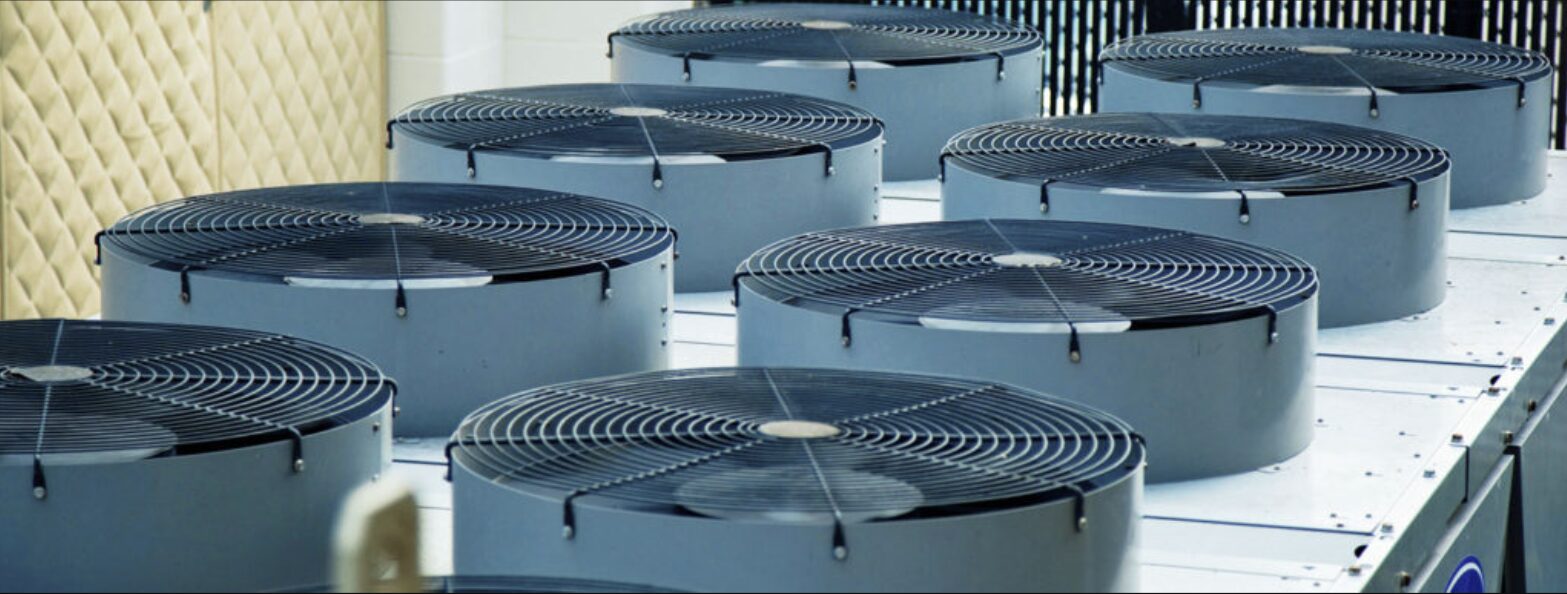
Industrial air handling units, with capacities from 25 kW and coverage of 300 sq. m or more, are installed wherever climate control has a direct impact on the production process. They maintain the air parameters that equipment and technology require, and Kliwenta’s specialists select the optimal configuration for each facility: stationary, modular, ducted, or a combined supply-and-extract system.
Ducted systems
Ducted air conditioning systems cool, heat and recover heat from indoor air. They are inexpensive, reliable and easy to operate – in winter they supply warm air thanks to heat recovery.
Precision air conditioning
Precision units use water- or refrigerant-based heat exchange and range from 2 to 129 kW. For medium-sized spaces, simpler mixed-type units are often sufficient.
Multi-zone systems
Where air purity requirements are stricter – hospitals, clinics, theatres – a multi-zone system is usually the best solution. Indoor and outdoor units can be up to 100 m apart without any loss of performance.
Installation
The durability and reliability of industrial air conditioning depends above all on the expertise of the team that designs, installs and maintains it. Kliwenta’s specialists handle every stage, helping clients avoid unnecessary costs down the line.
